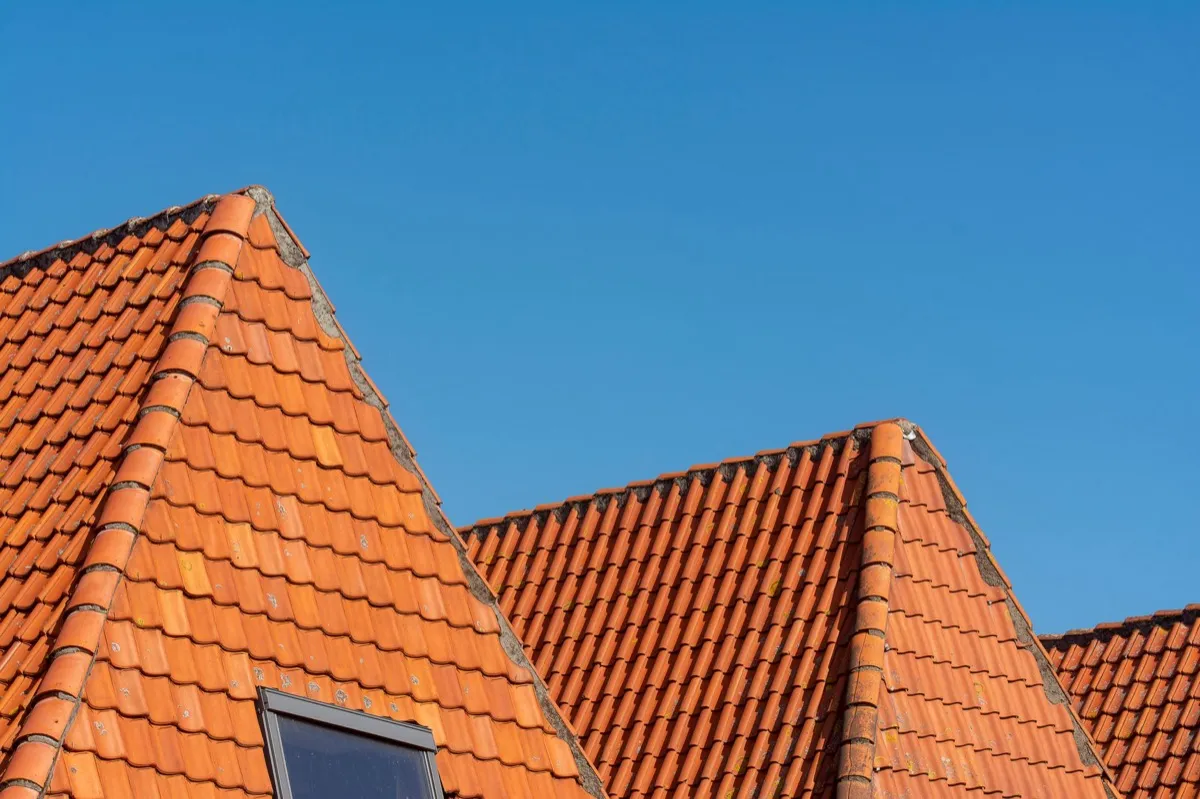
Spanish tile is a shape, not a material. The same barrel profile is pressed in fired clay, cast in concrete and molded in polymer, and those three weigh differently, cost differently, survive a freeze differently and break differently. The curve is all they have in common.
Which is why the first useful question about a tile roof is not about the tile. It is about what is holding it up.
Different types of roof tile, starting with the profile
Three profile families cover almost everything sold, and the names get swapped around constantly.
Two-piece mission, or barrel. A tapered half-cylinder laid concave up as a pan, with a second laid convex down over the joint as a cover. It descends from the Roman tegula and imbrex, arrived with Spanish colonial building, and took the name mission from the California missions. Two pieces per course means the most material, weight and labor.
One-piece S-tile. Pan and cover extruded as a single S in section, so one piece does the job of two. This is what most people picture when they say Spanish tile and what most such roofs actually are. It exists because the two-piece version is expensive and slow to lay.
Flat tile, including the French pattern. A flat plane with interlocking channels at the sides and a lock at the head. The interlock is the invention: the Gilardoni brothers patented it at Altkirch in Alsace in March 1841, and the Marseille tileworks took up the mold once the patent lapsed, which is why English calls the pattern French. The lock is why flat tile runs on a lower slope than a barrel can.
| Profile | Pieces per course | Reads as | Practical note |
|---|---|---|---|
| Two-piece mission / barrel | Pan plus cover | Deep, irregular shadow | Heaviest, most labor, most authentic |
| One-piece S-tile | One | Regular barrel rhythm | The volume product in every tile market |
| Flat / French interlocking | One | Slate or shake | Interlock does the weathering work |
The same shape in three different materials
Clay is fired, and its color is the body and its mineral oxides rather than a coating, so it does not meaningfully fade. It is also the most brittle and the most expensive.
Concrete is cast and cured. It absorbs more water than clay, so it gains weight in a storm and can bloom efflorescence early on. Pigment is either mixed through the body or sprayed on as a slurry, and the slurry-coated products are the ones that read chalky at twenty years.
Molded polymer, sold as composite or synthetic tile, imitates the profile at a fraction of the weight. Long warranty terms, short field record — that argument sits with the other non-asphalt coverings in how long does a metal roof last.
Weight is the first question, and it is a framing question
Roofing is specified by the square — 100 square feet of roof surface. What each covering puts on the structure permanently, against asphalt, because absolute figures move and ratios do not:
| Covering | Roughly, per square | Against architectural asphalt |
|---|---|---|
| Architectural asphalt shingle | 250–400 lb | Baseline |
| Molded polymer tile | 150–350 lb | About the same, sometimes less |
| Lightweight concrete tile | Under ~600 lb | Roughly 2x |
| Clay tile, one-piece | 600–1,000 lb | Roughly 2–3x |
| Standard-weight concrete tile | 900–1,200 lb | Roughly 3–4x |
| Two-piece mission clay | 950–1,500 lb | Roughly 4x, wet weight higher |
Published sources disagree inside those bands — some put ordinary clay at 600 to 650 pounds per square, others at 9 to 12 pounds per square foot installed, nearly double. The gap is mostly about whether battens, mortar and fasteners were counted. Ask both what the tile weighs and what the assembly weighs.
Now convert. A thousand pounds per square is ten pounds per square foot against something under three for asphalt. A conversion from shingle to clay or concrete tile adds on the order of six to eight pounds per square foot of permanent dead load to a structure framed for what it originally carried. That is not a roofing decision involving framing. It is a framing decision involving roofing.
The code side is legible. The IRC publishes its rafter span tables — R802.4.1(1) through (8) — in separate 10 psf and 20 psf dead-load versions, and the allowable spans in the second set are shorter. Asphalt over sheathing is a 10 psf assembly; clay or concrete tile, slate and multi-layer built-up push you toward the 20 psf tables. A house framed to the first and re-roofed into the second has not been evaluated for what it now carries. Where tile is normal, an engineer's evaluation before a conversion is routine and every contractor expects to be asked. Everywhere else it arrives mid-bid as a surprise, and the answer is reinforcing, a lightweight product or a polymer one.
Reroofing tile with tile does not raise this at all. The load has been there for decades. Converting is what raises it.
Freeze-thaw is why the tile map looks the way it does
Tile clusters in Florida, the Southwest and coastal California, and the usual explanation is fashion. Fashion is part of it. Absorption is the rest.
A fired tile has pore structure. Water sits in the pores, freezes, expands and spalls the face off in flakes, and once the face is open the next cycle works faster. So clay tile is graded for it: ASTM C1167 sorts clay roof tile into Grade 1 for severe frost exposure, Grade 2 for moderate and Grade 3 for negligible, on absorption and freeze-thaw testing. Concrete roof tile is covered by ASTM C1492, with its own freeze-thaw provisions for cold regions.
None of that bans tile in a cold climate. It is a specification, and one that gets ignored — a Grade 3 tile bought on price where it freezes says nothing about it until the third or fourth winter. Ask which grade is on the submittal, and treat a contractor who does not know as having answered a different question.
Two layers, and only one of them is tile
Tile is cladding, not a membrane. Whatever the body is pressed from, the assembly works the same way: driven rain gets past the profile routinely, and a membrane on the deck is what keeps the building dry. The tile above it is a durable, ventilated, ultraviolet-blocking shield, there to take the weather so the membrane does not have to.
Two consequences follow. A cracked tile rarely leaks on its own, because of that layer underneath — but it does uncover the layer to sunlight, which is the costlier problem. And the two age on different clocks, so a tile roof has two service lives, not one: how long a tile roof lasts works through both, and the comparison across coverings is in how long does a roof last.
Lift and relay, the job with no asphalt equivalent
When the membrane is done and the tile is not, the tile comes off and is stacked, the deck is re-covered, and the same tile goes back down. Nothing in asphalt works this way, because there the covering and the waterproofing wear out together.
Three things about the bill. It is mostly labor, since the expensive material is reused. It is not breakage-free — handling old tile costs a percentage of it, so the contract wants a stated allowance and a per-tile price. And if your profile has left production, replacements get salvaged from a yard or blended across slopes so the shortfall lands where nobody looks. Write the profile, manufacturer and color name into your file now, while the roof is fine.
A written roof inspection on tile is mostly an underlayment-age exercise plus a broken-tile count.
How tile actually breaks
Rarely by weather. In order:
People. Satellite installers, chimney sweeps, painters and solar crews walk tile badly. Tile is walked on the lower third of the exposed face, over the headlap where the tile below supports it — never the unsupported center, never hips and ridges. An afternoon of wrong footsteps produces a dozen hairline cracks nobody sees for two years.
Ridge and hip terminations. Older roofs bedded ridge tile in mortar, and mortar cracks and lets go. Mechanically fastened ridge on a raised nailer is current practice and behaves far better. Mortar crumbs in the gutters are the tell.
Perimeters and corners. Uplift concentrates at eaves, rakes, hips and corners, which is why fastening schedules are heaviest there. A tile that flew in a windstorm almost always started at a perimeter.
Bottom line
Establish the material first, because clay, concrete and polymer share a silhouette and nothing else. Converting from shingle is a structural project with a roofing phase, so get the load evaluated before you fall for a profile. In a freezing climate, ask for the frost grade. On a roof you already own, track the age of the underlayment rather than the tile — that is the number that decides when you spend. What moves the total is in roof replacement cost, and the long-ownership arithmetic behind an expensive roof is in metal roof vs shingles.
Two clocks run on a tile roof and only one is visible from the street. Lacey Roof Pros lifts tile to date the underlayment in Lacey and north Thurston County, then repairs or re-lays it: tile roof replacement, written roof inspections and storm damage restoration when a storm gets there first. Call (866) 841-2493 to learn which clock is closer to done.
Ready for a free quote in Lacey?
Lacey Roof Pros — free estimate, clear scope, no pressure. Use the form on this page or jump to the homepage quote.
Related services in Lacey
Lacey Roof Pros money pages — go straight to the service you need.
- Roof Replacement →
A tear-off in a Lacey subdivision is really two jobs on one invoice: the covering above the sheathing, and the water path that covering feeds. Most quotes price the first in detail and stay quiet about the second, which is how homeowners here get surprised in February.
- Storm Damage Restoration →
Storm work in Thurston County is mostly two things: what the wind took off, and what the trees put through. Neither arrives with the drama of a hailstorm, and both do more damage over a winter than most people expect from weather nobody bothers to name.
- Roof Inspections →
An inspection in this city has to cover ground that an inspection elsewhere does not, because the usual free diagnostics do not work here. On a Lacey lot the yard tells you nothing, and a report that only looks up misses the half of the system that is buried.
- Roof Leak Repair →
Diagnosis here starts with a question most roofers skip: when does the stain appear, and does it go away. That single answer separates a genuine roof leak from the two things Lacey homeowners mistake for one, and it costs nothing to establish before anybody climbs a ladder.
- Hail Damage Roofing →
This is the page on which we most often talk somebody out of something. Hail claims filed on Lacey roofs mostly fail, and they fail on the adjuster's own test rather than on anything a roofer argues, so it is worth knowing what that test is before you file anything.
Frequently asked questions
Is Spanish tile clay or concrete?
Either, and increasingly neither. Spanish tile names a profile — the rounded barrel section — and manufacturers press that same profile in fired clay, in cast concrete and in molded polymer. From the sidewalk at forty feet they are hard to tell apart. On a scale, on a bid and in a freeze they are three separate products. Ask which material before you ask anything else, because every other answer changes with it.
What are the different types of roof tile?
By profile there are three families. Two-piece mission or barrel tile is a pan laid concave up with a separate cover laid over the joint, which is the oldest arrangement and the heaviest.
One-piece S-tile combines pan and cover into a single S-shaped extrusion, which is what most people picture when they say Spanish tile and what most such roofs actually are. Flat tile, including the interlocking French pattern, lies flat like slate and locks to its neighbors at the sides and head. Each of those comes in clay, concrete or polymer.
How much does a tile roof weigh compared to shingles?
Several times as much. Architectural asphalt runs roughly 250 to 400 pounds per square, where a square is 100 square feet of roof. Clay tile commonly runs 600 to 1,000 pounds per square and standard-weight concrete 900 to 1,200, with two-piece mission clay quoted as high as 1,500. Lightweight concrete sits under 600.
Molded polymer is the outlier at roughly 150 to 350, which is asphalt territory. Published figures disagree inside those bands depending on whether battens, mortar and fasteners were counted. So the same profile can multiply your roof load by three or barely change it.
Can any house take a tile roof?
No, and this is the question people skip. Going from asphalt to clay or concrete tile adds something like six to eight pounds per square foot of permanent dead load to a structure that was framed for what it originally carried.
The IRC publishes its rafter and ceiling joist span tables in separate dead-load-10 and dead-load-20 versions for exactly this reason. In tile markets a structural evaluation before a conversion is routine and everybody expects it. Outside them it comes as a surprise, and the surprise is usually reinforcing or a lighter product.
Does tile work in a cold climate?
Clay tile works in a freeze only if it was graded for one. ASTM C1167 sorts clay roof tile into Grade 1 for severe frost exposure, Grade 2 for moderate and Grade 3 for negligible, and the sorting is largely about how much water the fired body absorbs. Water in a pore that freezes is what spalls a tile face.
Concrete roof tile has its own standard, ASTM C1492, with freeze-thaw provisions for cold regions. Tile clusters in warm markets partly by tradition and partly because the cold-rated products cost more and the installation details get fussier.
Why do tile roofs need new underlayment if the tile is fine?
Because the tile was never the waterproofing. Clay, concrete and polymer are all cladding: durable, ventilated shields fastened over a membrane, and the membrane is the layer keeping the building dry. It ages on a much shorter clock than any of the three tile bodies do.
When it goes, the tile is stripped, stacked, the deck is re-covered and the same tile goes back down. The trade calls it a lift and relay, there is no asphalt equivalent, and it is a labor bill rather than a materials bill.
Local context
How this applies in Lacey, WA
Every article here is written from roofing work done in Lacey and north Thurston County, so the numbers reflect local labour, permit and material costs rather than a national average. Your own job can land either side of them depending on access, the condition of what is already there, and the materials you pick — downspout infiltration trench sized from the roof area draining into it, washed drain rock jacketed in geotextile under six inches of compacted backfill, a rodding cleanout tee set where the leader meets the buried lateral.
The way to turn any of this into a real answer is to have someone look at your actual situation. The free estimate is free, itemized and written down, with no deposit and no obligation. Call (866) 841-2493 or start on the Lacey Roof Pros homepage.
Areas Lacey Roof Pros covers
Lacey first, then the surrounding communities of north Thurston County. Each has its own page with local detail rather than a copy of this one:
- Tumwater, WA — Thurston County, population 25,350
- Yelm, WA — Thurston County, population 10,617
- Tenino, WA — Thurston County, population 1,870
- Rainier, WA — Thurston County, population 2,369
- Bucoda, WA — Thurston County, population 600
- Tanglewilde, WA — Thurston County, population 6,265
Or jump to the full list of Lacey services.
More from the Lacey Roof Pros blog
- Roof Ridge Vent Installation Cost in Lacey: Timing Sets It
A ridge vent is close to free during a re-roof and a real job as a retrofit in Lacey, WA. The drivers, the ratios, and the line item most quotes leave out.
- Roof Moss Treatment in Lacey: Why the Fast Method Ends the Roof
Moss on asphalt shingles has one correct treatment and one destructive one that sells better. What ARMA and the shingle warranties actually say, and what it costs in Lacey, WA.
- Roof Hip and Valley in Lacey: Why Only One of Them Leaks
A hip sheds water away from itself. A valley concentrates it.
The Lacey Roof Pros Team
roofing specialists serving Lacey, WA
Written by the Lacey Roof Pros team — insured roofing pros serving Lacey, WA and the surrounding area.